€16M of turnover our Client's platform generates per week
  36,360 request / per second are supported by one of our systems
  German B2C and B2B transactional portals run on the framework we are developing!
 Casino game aggregation is not enough
Casino game aggregation solved one of the biggest content problems in iGaming.
Instead of integrating every studio separately, operators can connect to one aggregator and access a large library of slots, live casino games, crash games, table games, jackpots and other casino content through a single API. This makes launches faster, market expansion easier and content management less painful.
But aggregation also creates a different problem.
When an operator adds thousands of games from dozens or hundreds of providers, the game lobby becomes harder to control. A game may be visible, but not working. A provider may be integrated, but unstable. A launch may succeed in one country and fail in another. A slot may load on desktop and break on mobile. A wallet update may be delayed. A bonus round may not behave as expected. A game may pass pre-launch QA and still fail after a provider update.
The operator does not own every moving part, but the player does not care.
From the player’s point of view, the casino either works or it does not.
This is why casino game aggregation is no longer enough on its own. Operators need real-time game monitoring, automated QA checks and better visibility into provider-level performance. A large game library is useful only when the operator knows which games are actually working.
Game aggregation solved integration, not quality
The strongest promise of a casino game aggregator is simple: connect once and access many providers.
That promise is valuable. It reduces technical complexity, speeds up content rollout and helps operators expand their game portfolio without managing separate integrations for every studio. For new operators, it can shorten the path to market. For established brands, it can make content scaling more manageable.
But aggregation should not be confused with quality control.
An aggregator can simplify access to content. It can standardise part of the integration layer. It can help with provider management, reporting, game feeds and sometimes promotional tools. But it does not remove every operational risk from the casino product.
The moment the game library grows, the operator inherits a much larger surface area for errors.
Each provider has its own systems. Each game has its own logic. Each market may have different availability rules. Each device and browser can behave differently. Each update can change something that worked yesterday.
This is where the hidden cost of aggregation appears.
The operator may have more content, but also more things to monitor.
Available in the lobby does not mean working for the player
One of the biggest mistakes in casino operations is assuming that a game is fine because it appears in the lobby.
Lobby visibility is not the same as playability.
A game can be listed correctly and still fail during launch. It can launch but freeze after login. It can open but fail to connect to the wallet. It can accept the first bet and then return an error. It can work in one browser and fail in another. It can be available in the back office but blocked by provider-side geo rules. It can load slowly enough that players abandon it before the first spin.
These are not theoretical problems. They are everyday operational issues in online casino platform maintenance.
The player usually does not report them in detail. Most players do not write support tickets saying that the provider returned a timeout after wallet authentication. They simply leave the game, try another operator or stop trusting the brand.
That makes broken game experiences difficult to measure if the operator only looks at support tickets.
A low complaint volume does not always mean the library is healthy. It may simply mean that players are not taking the time to explain technical failures.
The operational risks behind large game libraries
A large casino library introduces several types of risk.
The first is game launch failure. The player clicks a title, but the session does not start. This may be caused by provider downtime, API errors, wrong configuration, expired tokens, market restrictions or frontend issues.
The second is wallet desynchronisation. The game opens, but the balance does not update correctly, a bet is not reflected in real time or a win appears with delay. In real-money gambling, even small balance confusion can damage trust.
The third is device-specific failure. A game may work in desktop Chrome and fail on mobile Safari. It may behave differently on older Android devices. It may break inside an in-app browser. A manual test on one device does not prove that the game works for the majority of players.
The fourth is bonus and free spin failure. Promotional mechanics often depend on correct communication between the platform, aggregator and provider. If free spins do not trigger, wagering progress is unclear or bonus rounds behave unexpectedly, the issue becomes both technical and commercial.
The fifth is provider-level instability. A single provider can affect hundreds of games. If the operator has no monitoring by provider, it may treat each failure as an isolated case instead of identifying the real source.
The sixth is market availability mismatch. A title may be active in the system but unavailable or restricted in a specific country. For multi-market operators, this can create inconsistent player experiences across regions.
The seventh is performance degradation. A game may technically work, but load too slowly, lag during play or fail under traffic spikes. For the player, “slow” often feels the same as “broken”.
These problems do not disappear because the content came through one API.
Manual QA does not scale
Manual QA is still important in iGaming. People are better at spotting confusing flows, visual issues, unclear bonus communication and strange gameplay behaviour.
But manual QA alone cannot protect a large aggregated library.
If an operator has thousands of games, checking them manually every day is unrealistic. Even checking a meaningful sample across devices, providers, markets and player states can become too slow. The problem becomes bigger every time the operator adds a new provider, enters a new market or launches a new promotional mechanic.
Pre-launch testing is also not enough.
A game can work correctly before release and fail later because of a provider update, platform change, wallet configuration issue, CDN problem, device-specific bug or market restriction update. In aggregated casino environments, the product is not static. It changes constantly.
This is why online casino game testing needs an operational layer after launch.
The operator should not only ask whether a game passed QA before it went live. The more important question is whether it still works today.
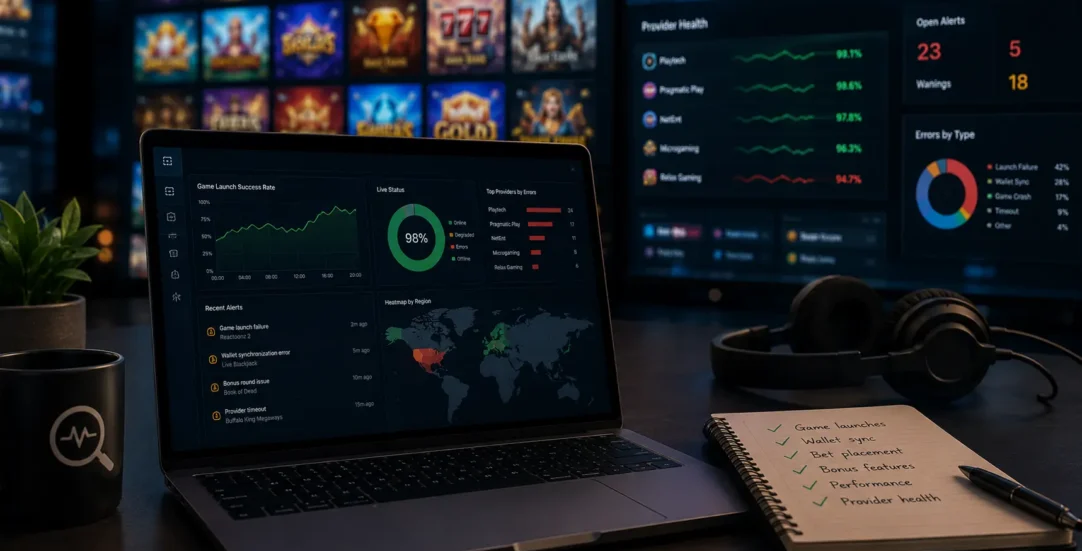
What real-time game monitoring should check
Real-time game monitoring should focus on the player journey, not only on technical uptime.
A provider endpoint may respond, but the player can still fail to play. That is why monitoring should cover the key steps that matter from the user’s point of view.
The first check is game visibility. Is the game present in the lobby where it should be available?
The second check is launch. Can the game session start successfully for the right market, device and player state?
The third check is authentication. Does the game receive the correct session and player context?
The fourth check is wallet connection. Is the balance displayed correctly? Does it update after a bet, win or loss?
The fifth check is gameplay flow. Can the game accept a bet and complete a basic round without error?
The sixth check is bonus handling. Do free spins, bonus rounds or promotional mechanics behave as expected?
The seventh check is error capture. If the game fails, does the operator know whether the issue came from the provider, aggregator, platform, device, market restriction or wallet layer?
The eighth check is performance. How long does the game take to load? Does it time out? Does the experience degrade on mobile networks?
The goal is not to play every game like a human player for hours. The goal is to detect whether the critical path works before players discover the problem first.
Game observability is different from uptime monitoring
Traditional uptime monitoring asks whether a system is available.
Game observability asks whether the product experience is working.
That difference matters.
A provider can be online, but a specific game can fail. The aggregator can respond, but the wallet can desynchronise. The platform can be live, but mobile launches can break. The lobby can display a title, but the game can be unavailable in a certain market.
Operators need visibility at several levels: game, provider, market, device, session and player journey.
This allows teams to answer practical questions.
Which games are failing most often?
Which providers create the highest error rate?
Are failures concentrated in one market?
Do mobile players see more launch issues than desktop players?
Are bonus-related errors more common after a campaign launch?
Did a provider update break a previously stable title?
Are players abandoning during loading, authentication or gameplay?
Without this level of visibility, the team works reactively. It waits for complaints, checks individual cases and fixes only the errors that become visible.
Game observability turns casino operations into a more controlled process.
The business impact of broken games
A broken game is not only a technical issue.
It affects revenue, retention, trust and support costs.
When a player cannot launch a game after making a deposit, the operator may lose the first session. When a player sees balance confusion, trust drops immediately. When free spins fail, the player may assume the promotion was misleading. When a favourite provider becomes unstable, loyal players may leave without telling support why.
Broken games also create hidden commercial damage.
Marketing may keep sending traffic to a casino lobby where part of the content does not work properly. CRM may promote games that are failing for certain devices. VIP teams may recommend titles with provider-side issues. Paid campaigns may acquire players into a broken first experience.
This is why game monitoring should not sit only with QA.
Product, CRM, payments, support and operations teams all benefit from knowing which parts of the game library are healthy.
A game issue can become a retention issue very quickly.
Provider monitoring helps operators act faster
Large casino libraries need provider-level analysis.
If ten games from the same studio fail within the same time window, the operator should not investigate them as ten unrelated issues. It should be able to identify the provider pattern and act faster.
Provider monitoring can help teams decide whether to hide affected games, pause promotions, notify account managers, reroute traffic, update support scripts or escalate the issue to the aggregator.
It also helps with long-term provider management.
If one provider repeatedly creates launch issues, slow loading, wallet errors or high support volume, the operator needs data. Not opinions. Not scattered Slack messages. Not occasional complaints. Actual performance evidence.
This can influence lobby placement, campaign planning, commercial negotiations and future content strategy.
Game aggregation makes it easier to access many providers. Monitoring makes it easier to understand which providers are reliable.
Automated testing should support human QA
Casino game QA automation should not try to replace human judgement entirely.
Instead, it should remove repetitive checks from manual teams and catch obvious failures earlier.
A human tester should not have to spend hours opening the same games every morning to see whether they launch. Automation can handle recurring checks across selected games, providers, markets and devices. Human testers can focus on edge cases, user experience, bonus clarity, visual behaviour and deeper investigation.
This creates a better QA model.
Automated checks can run frequently and detect failures early. Human QA can investigate the issues that actually need interpretation. Operations teams can receive alerts before support tickets increase. Product teams can see trends across the library.
The result is not less QA.
It is QA that scales with the size of the game portfolio.


The role of monitoring after launch
Many iGaming teams treat launch as the finish line.
In casino operations, launch is only the beginning.
A game can pass certification, provider testing, internal QA and production release, then still create issues later. The live environment includes real traffic, real devices, real markets, real wallets, real payment states and real promotional campaigns. That is where many issues appear.
Post-launch monitoring is especially important when operators expand quickly.
New markets introduce different devices, network conditions, regulations, payment behaviours and content restrictions. A game library that works well in one region may not perform the same way in another. The same aggregator setup may require local checks to confirm that players can actually access and play the right titles.
This matters even more in emerging markets, where mobile performance, connection quality and payment behaviour can vary widely.
An operator entering a new market should not only ask whether the game portfolio is available.
It should ask whether the portfolio works under local conditions.
From content volume to content reliability
For years, casino operators competed partly on content volume.
More games. More providers. More categories. More live dealer tables. More crash games. More jackpots. More mechanics.
Content depth still matters, but it is no longer enough.
When many operators can access similar providers through aggregators, the advantage shifts from having content to operating content well. The quality of the lobby, the reliability of launches, the speed of loading, the accuracy of wallet updates and the handling of provider issues become more important.
A smaller library that works reliably can create a better experience than a huge library full of silent failures.
This does not mean operators should reduce their game offering. It means they need a stronger operational layer around it.
Game aggregation gives access.
Game monitoring gives control.
Why this matters for platform teams
Real-time game monitoring is not only a QA topic. It is a platform topic.
It affects backend integration, frontend experience, provider management, wallet logic, reporting, support workflows and incident response. If game failures are not visible in a structured way, teams waste time finding the source of the problem.
A good monitoring setup helps teams move from vague reports to clear diagnosis.
Instead of “some games are not working”, the team can see which provider, which market, which game, which device and which step in the journey failed. That makes escalation faster and fixes more precise.
It also helps avoid unnecessary blame.
Not every issue is caused by the operator platform. Not every issue is caused by the aggregator. Not every issue is caused by the provider. Sometimes the problem sits in configuration, session handling, wallet sync, market restrictions or frontend behaviour.
Monitoring gives teams the evidence they need to act instead of guessing.
The next layer of casino operations
Casino game aggregation will remain important. Operators still need fast access to providers, flexible content management and simplified casino API integration.
But the next operational layer is clear.
Operators need to know whether their aggregated content is working in the real world.
That means checking games continuously, monitoring provider behaviour, detecting launch failures, tracking wallet issues, understanding device-level problems and connecting QA data with product and support workflows.
The goal is not to create another dashboard that nobody uses.
The goal is to prevent players from becoming the monitoring system.
When players are the first people to discover broken games, the operator is already late. The session may be lost. The deposit may be wasted. The promotion may be damaged. The trust may be gone.
Modern iGaming platforms need to treat game reliability as part of the product experience.
A casino game aggregator can help operators scale their content library. Real-time game monitoring helps them protect the quality of that library.
In a market where many brands offer similar games, reliability becomes a competitive advantage.