€16M of turnover our Client's platform generates per week
  36,360 request / per second are supported by one of our systems
  German B2C and B2B transactional portals run on the framework we are developing!
 Detect slot bugs before regulators do with PlayPatrol

You push a new slot build to production. On your local staging environment, the reels spin flawlessly. The mathematical models align perfectly with your theoretical documentation. The bonus rounds trigger exactly as designed across all simulated test cases. Then reality hits. Two days later, a major tier-one operator escalates a critical issue. The game is freezing during free spin features on mobile devices in a specific European jurisdiction. You are the last to know, and your entire development team immediately drops everything to enter a chaotic fire-fighting mode. This highlights a common limitation of traditional QA approaches.
Your games might work perfectly in theory, but they behave entirely differently once deployed into an operator wrapper. Operators inject their own custom user interface overlays, promotional widgets, and cascading style sheets directly on top of your game canvas. These external elements frequently conflict with your code, breaking critical touch inputs or obscuring essential betting buttons. Relying on your client to act as an unpaid live slot testing service can erode vendor trust over time and may negatively impact future integration opportunities.
The online gambling sector is an unforgiving environment driven entirely by mathematical precision and uninterrupted uptime. Industry metrics indicate that slot games generate roughly seventy percent[1] of total online casino revenue globally. An average digital casino adds up to ten new titles every single month just to maintain player retention and satisfy content demands. This aggressive release cadence forces studios to push builds out the door rapidly, often compromising the depth of their pre-release regression checks.
Every single undetected flaw that survives the deployment pipeline costs your studio money and damages your brand reputation. When an operator finds a broken payline or a frozen spin button on their live floor, the blame falls entirely on the provider. Escalations lead to paused rollouts, suspended marketing campaigns, and tense meetings with operator management teams. Deploying a continuous iGaming production monitoring tool is one of the most effective ways to catch these regressions before the operator ever notices them.
The silent death of operator trust
Silence frequently masks the most expensive software malfunctions in the casino sector. Revenue leaks quietly while faulty random number generators process thousands of mathematically skewed spins in the background. The originating studio remains completely blind to the malfunction occurring on the operator side of the transaction because they lack direct visibility into the live environment. Implementing a proactive casino bug detection system bridges this severe visibility gap before financial damage multiplies beyond repair.
Scaling a quality assurance department by hiring more manual human testers rarely equates to higher release confidence. Larger QA teams inevitably create communication bottlenecks, slower release cadences, and highly inconsistent bug reporting protocols across different shifts. Throwing more humans at a rapidly expanding game portfolio does absolutely nothing to reveal what actually happens on the operator’s live website after the code officially ships. Integrating an automated slot machine QA framework is a highly effective approach for studios aiming to scale production safely.
Different geographical locations demand entirely unique software behaviors from the exact same game build. A title certified for the British market must act completely differently than the exact same binary deployed in a newly regulated Latin American jurisdiction. Studios traditionally lack any reliable method to monitor these granular post-deployment behaviors across diverse regions. Utilizing automated multi-jurisdiction slot verification provides a reliable way to mitigate against these localized software failures and compliance breaches.
Edge cases represent the most dangerous blind spots in traditional software evaluation cycles. Unusually long gameplay sessions, obscure symbol mapping combinations, and extremely rare jackpot triggers rarely receive adequate manual scrutiny from human testers. QA engineers simply lack the bandwidth or patience to manually spin a machine for twelve consecutive hours hunting for a memory leak. An intelligent AI player simulation tool systematically explores edge cases that are impractical to test manually.
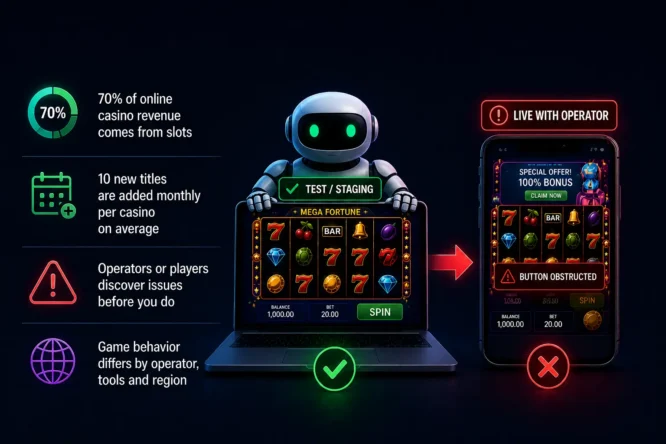
Why manual slot QA is breaking
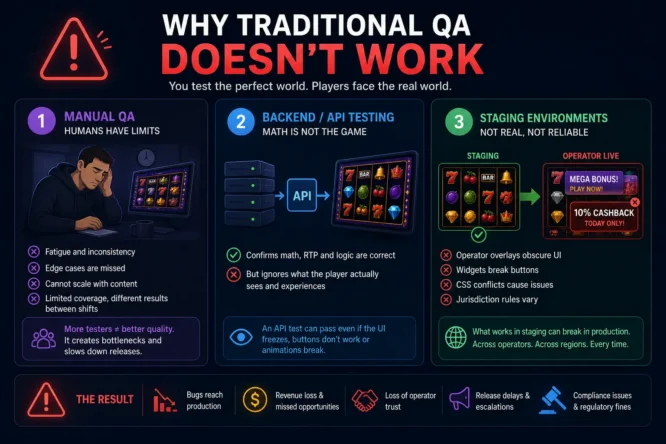
Manual testing processes simply cannot keep pace with the massive output of contemporary slot development studios. Human testers struggle with eye fatigue, inconsistent execution, and the sheer physical impossibility of executing millions of spins by hand. A human looking at a bright screen for eight hours will inevitably miss a subtle graphical glitch occurring on frame forty-two of a complex reel animation. Transitioning to a dedicated automated visual QA pipeline replaces fragile human attention with tireless, frame-perfect machine precision.
Relying entirely on backend code validation creates a highly dangerous false sense of security for technical teams. Traditional automated frameworks hook directly into the application programming interface, confirming the math works but completely ignoring the visual presentation the player actually sees. An API test will happily report a successful jackpot trigger even if the frontend graphical interface has completely frozen on the player’s mobile screen. Utilizing a strict frontend pixel validation engine ensures the player actually experiences the winning sequence the server calculated.
Studios lose absolute control of their software the moment it integrates into a third-party casino environment. If your game runs perfectly on a local server, that data is entirely useless if an operator’s aggressive chat widget overlaps your spin button. Traditional QA tools that require API access or code integration cannot test these external environmental factors. A modern browser-level interaction bot navigates these chaotic live environments exactly like a real user, revealing UI conflicts instantly without any backend access.
When a critical failure occurs, studios waste countless hours attempting to reproduce the exact conditions of the crash. Operators submit vague, unhelpful complaint tickets, often lacking essential server logs, exact timestamp data, or detailed reproduction steps. Developers are left blindly guessing how a specific combination of scatter symbols managed to lock the entire user interface. An automated video recording QA system eliminates this friction entirely by capturing the exact sequence of events leading to the catastrophic failure.
PlayPatrol changes the QA game
Modern game development demands an entirely new approach to post-deployment quality assurance and live monitoring. PlayPatrol operates as an advanced artificial intelligence platform designed specifically to play digital slots exactly like a human consumer. It systematically navigates live casino sites, locates specific titles in crowded lobbies, places dynamic wagers, and physically clicks the virtual spin buttons. This revolutionary AI driven slot testing software completely redefines how studios monitor the health of their active game portfolios.
Intrusive testing methodologies require complex integration phases that slow down deployment velocity and frustrate engineering teams. PlayPatrol fundamentally differs from traditional tools because it operates entirely from the outside as a true black-box system. It requires zero API hooks, absolutely no access to your studio’s source code, and creates zero interference with your delicate production servers. If a slot game renders inside a standard web browser, this zero-integration testing platform can analyze it flawlessly from the outside in.
Scripted test cases fail miserably because human players act unpredictably and erratically during real-world gaming sessions. The PlayPatrol artificial intelligence mimics genuine user behavior, interacting with mechanics in live, unscripted conditions that scripts cannot predict. It varies bet sizing, clicks through menus rapidly, triggers bonus rounds, and navigates complex feature screens just like a paying customer would. This organic behavioral gameplay simulation exposes fragile logic paths that rigid, linear test scripts consistently overlook.
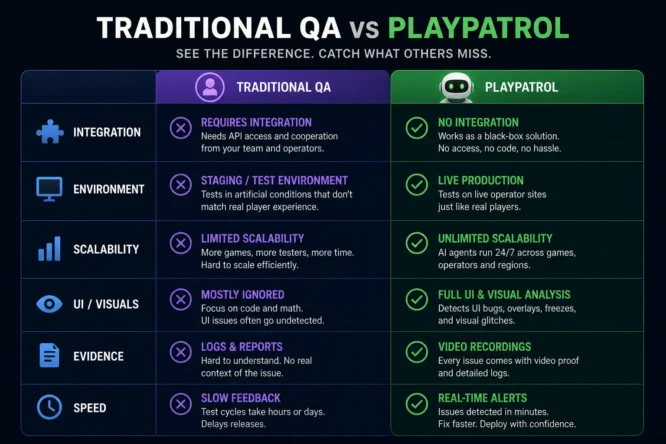
| Feature | Traditional QA | PlayPatrol AI |
| Integration | Requires API hooks and source code access. | Zero integration, operates as a black-box player. |
| Environment | Tests on sterile local staging servers. | Tests directly on live operator casino websites. |
| Evidence | Manual text logs and Jira tickets. | Auto-generated video recordings of every bug. |
| Scaling | Limited by human headcount and hours. | Infinite automated scaling across all jurisdictions. |
| UI Testing | Misses operator wrapper and CSS conflicts. | Sees exactly what the player sees on the screen. |
Tracking the financial accuracy of a session requires constant, real-time mathematical analysis of the user interface. The platform continuously monitors the shifting session flows, analyzing how raw gameplay visual data impacts the user’s overall balance counter. It aggressively hunts for any hidden anomalies that might skew the perceived return rate, break session continuity, or cause balance desynchronization. Leveraging this real-time slot balance tracker helps prevent scenarios where operators may overpay due to a silent logic inversion on the frontend.
Walking into an operator meeting with a recorded failure completely changes the dynamic of the technical conversation. The AI captures the exact video path, takes high-resolution screenshots, and compiles a comprehensive error description ready for immediate sharing with developers. Artificial intelligence automatically classifies pass/fail outcomes based on predefined criteria, ensuring the development team only reviews genuine, verified defects. This highly streamlined automated bug reporting workflow drastically reduces the time required to triage and patch critical production issues.
Monitoring should never stop the moment a game receives regulatory certification and goes live. The exact same testing platform used for pre-release validation must run continuous health checks on the live production environment. This ensures that sudden operator platform updates or unannounced server migrations do not silently break your game integration. Implementing a relentless post-deployment health monitor helps maintain high uptime and consistent performance across all hosted environments globally.
Inside the UKGC regulatory matrix
Government oversight bodies heavily penalize platforms that expose vulnerable players to faulty mathematics or deceptive slot graphics. The United Kingdom Gambling Commission actively monitors the industry for any technical failures that affect player returns or violate open licensing objectives. A game underpaying its advertised theoretical return directly undermines consumer confidence in the entire digital betting ecosystem. Studios must deploy strict regulatory compliance testing software to avoid attracting regulatory scrutiny of these powerful enforcement agencies.
Reporting faulty mechanics is a strict legal requirement in regulated markets, not a voluntary professional courtesy. Ordinary code provision 15.2.1 mandates the immediate reporting of any technical event affecting the financial return of a deployed title. Regulators use this specific telemetry to identify systemic weaknesses in how modern studios design, develop, and deploy their digital slot products. Failing to utilize an algorithmic slot fault detection engine leaves studios completely exposed to devastating, public enforcement actions.
The regulatory framework dictating game design has grown exponentially more complex and restrictive over the last few years. Recent updates to the Remote Technical Standards mandate severe limitations on how digital reels can operate and display visual results. Features designed to artificially accelerate gameplay or create a false illusion of player control are now strictly prohibited by law. Ensuring absolute RTS 14 compliance testing is an absolute, non-negotiable necessity for any studio targeting the lucrative British gaming market[2].
Enforcing mandatory spin speeds
Speed limits now fundamentally alter the mathematical rhythm and visual pacing of modern reel-based titles. The commission strictly requires a minimum duration of 2.5 seconds from the initiation of a spin until the next cycle can legally commence. Players must also be forced to physically release and depress the start button for every single round, slowing the rate of play. Verifying this exact timing requires highly precise frame-rate performance monitoring to mathematically prove the delay meets legal regulatory thresholds[3].
Banning simultaneous slot play
Operators face strict prohibitions regarding the deployment of concurrent betting interfaces and multi-game lobbies. The technical standards forbid any functionality that facilitates playing multiple products simultaneously via split screens or custom multi-window displays. This rule exists to prevent players from accelerating their financial loss rate by spinning several different high-volatility games at once. Deploying an external casino platform scanner ensures the hosting website does not accidentally merge multiple game iframes into a forbidden layout.
The end of slot autoplay features
Removing friction from the betting experience is no longer a legally viable design strategy in heavily regulated environments. Regulators completely banned all autoplay functionality for online slots, forcing consumers to individually commit to every single game cycle. Software cannot automatically deduct funds and initiate a spin without direct, intentional, and physical human intervention on the interface. An intelligent operator environment simulator easily verifies that no hidden background scripts bypass this critical player input requirement.
Displaying the player net position
Transparency regarding financial loss is a foundational requirement of modern responsible gambling initiatives globally. The RTS 2E mandate requires every gaming session to clearly display the consumer’s net position since the session originally began. This visual counter must perfectly calculate total winnings minus total losses, updating flawlessly in real-time on the screen. Utilizing a dynamic ledger validation testing tool ensures this critical UI element never freezes or desynchronizes from the central banking database[4].
A broken net position display may trigger regulatory investigations and result in significant financial penalties for the hosting operator. If a player loses track of their spending because a graphical element froze, the operator holds absolute legal liability for the session. Testers must verify that this counter survives network disconnects, sudden browser refreshes, and mobile device rotation events. An automated environment persistence testing script forcefully interrupts the connection, ensuring the financial display recovers its exact accurate state upon reconnection.
When slots celebrate player losses
Technical standards specifically prohibit mechanics that deceive players about the harsh reality of their gaming session. The UKGC considers it highly predatory to trigger flashing lights and celebratory audio when the player actually lost money. A gambling system must never celebrate a return which is less than or equal to the total stake gambled on that specific spin. A dedicated visual computer vision tracker is required to identify these deceptive graphical overlays before regulators issue punitive public fines.
Obscuring the financial reality of a session represents a direct, actionable violation of remote technical standards. The Commission notes that false celebratory effects negatively impact a player’s ability to interpret their gameplay accurately and make informed financial choices. Manually verifying that an audio file does not trigger during a net-loss spin across thousands of possible game states is practically impossible. Utilizing automated screen-based element validation ensures every required counter and celebration logic gate renders properly on the final operator site.
Heavy fines for UKGC non-compliance
Recent enforcement actions demonstrate exactly how aggressively regulators pursue software and operational non-compliance across the sector. Petfre absorbed a massive £240,000 penalty for operating a selection of slot games that actively celebrated financial losses as if they were massive victories. The operator was forced to take immediate action and promptly decommissioned all affected games from their active portfolio. This public shaming proves that lacking a proactive game compliance scanner leads directly to severe financial and reputational damage.
| Operator | Fine Amount | Primary regulatory violation |
| Petfre | £240,000[5] | Slots celebrated losses as wins; failed to display net position. |
| Videoslots | £650,000[6] | Deposit limit logic failed; players exceeded limits due to software bugs. |
| Merkur Slots | £95,450[7] | Failed to trigger interactions during prolonged gambling sessions. |
| Platinum Gaming | £10,000,000[8] | Massive systemic failures in customer interaction and software triggers. |
The financial consequences for systemic monitoring failures often reach well into the millions of pounds. Videoslots absorbed a staggering £650,000 fine because their internal systems failed to properly calculate calendar-spanning deposit limits accurately. Customers lost thousands of pounds in mere hours while the broken monitoring architecture remained completely silent and inactive. Implementing an independent third-party slot audit tool ensures these vital safety mechanisms actually function as intended under heavy, real-world player loads.
Even land-based and omnichannel operators face relentless scrutiny for technical and procedural breakdowns. Merkur Slots recently faced a substantial financial penalty of £95,450 for severe social responsibility failings at one of their locations. The operator permitted a customer to gamble continuously for hours without triggering required interaction protocols or software limits. A comprehensive behavioral anomaly detection platform could have easily flagged this prolonged session and forced a system intervention before the violation ever occurred.
Tracking actual vs theoretical RTP
The difference between theoretical calculations and real-world results dictates the ultimate profitability of a casino. Mathematical models predict the return based on millions of simulated rounds executed in sterile, controlled laboratory conditions. However, the actual observed return in a live environment fluctuates wildly based on variance and specific player actions over short timeframes. Maintaining an active live RTP monitoring tool confirms that short-term volatility does not mask a catastrophic mathematical software failure.
| RTP Metric | Definition | Calculation method | Stability profile |
| Theoretical RTP | Predicted return based on math models. | Billions of simulated rounds. | Fixed unless game math is updated. |
| Actual RTP | Observed return from live players. | Real wagers and payouts tracked. | Fluctuates heavily due to variance. |
Detecting a broken math model requires observing significant volumes of live gameplay data over extended periods. A minor discrepancy over fifty spins means nothing, but a sustained two percent overpayment over a million spins indicates a severe software flaw. Analysts use a ninety-five percent confidence interval to determine if a slot machine is operating within mathematically acceptable tolerances. A statistical variance analysis platform automatically flags any game that bleeds revenue beyond these strict, legally defined standard deviations.
Game developers must account for the natural volatility inherent in high-variance mathematical slot designs. A slot machine equipped with a massive progressive jackpot will experience extreme swings in actual return percentage before the grand prize hits. A simple short-term measurement might falsely flag a perfectly legal game as defective purely due to statistical noise. A long-term variance tracking engine calculates these massive datasets, accurately differentiating between acceptable mathematical swings and genuine, exploitable software flaws.
Financial tracking errors destroy operator profitability faster than any other technical defect in the industry. A glitch that misinterprets a betting amount or incorrectly awards a jackpot causes immediate, irreversible financial damage to the host casino. These server-to-client desynchronizations often stem from deeply buried programming errors that evade initial laboratory certification completely. Utilizing a continuous slot logic validation engine catches these specific math conflicts before thousands of players discover and exploit them.
Reporting RTP faults to the UKGC
Ignorance of a software defect provides absolutely no defense against regulatory enforcement or public sanctions. The gambling commission uses information on software faults to evaluate risk across the entire sector, identifying systemic weaknesses in game deployment. Operators must provide highly detailed reports outlining the nature of the incident, the financial amount involved, and the remedial actions taken. Maintaining an automated slot incident logging system provides the exact forensic data required to satisfy these demanding regulatory disclosures.
The UKGC reporting framework demands absolute precision regarding how a fault successfully bypassed internal and external testing protocols. If a mathematical design flaw results in an incorrect prize frequency, the studio must explain the root cause of the failure thoroughly. Furthermore, the operator must endeavor to return any unfairly lost money to the affected customers in a timely, documented manner. Integrating a transactional rollback testing module ensures the system can accurately calculate and process these required financial corrections without causing further database corruption.
Regulators view a cluster of minor faults as a potential indicator of a wider systematic issue within an operator’s processes. Even an apparently minor game underpayment issue represents a massive failure in the design, build, testing, or deployment of a gambling product. Prompt identification, immediate game deactivation, and rapid notification of faults increases regulatory confidence that you are properly monitoring your products. Detecting minor variances using advanced live telemetry monitoring processes demonstrates you have highly effective compliance systems in place.
MGA requirements for slot testing
The Malta Gaming Authority enforces its own rigorous set of technical demands for digital casino software providers. Securing an MGA license requires studios to submit their software architectures for exhaustive examination by approved independent testing laboratories. The system must utilize proper cryptographic tools to protect sensitive player data from unauthorized manipulation or external extraction attempts. Maintaining a certified random number generator protocol guarantees all spin outcomes remain completely fair, verifiable, and fully auditable by authorities.
Acquiring regulatory approval demands comprehensive technical documentation and flawless mathematical proofs submitted directly to the commission. Laboratories dissect the gaming engine, analyze the core technical specifications, and run millions of simulated rounds to verify the baseline math. Any discrepancy between the advertised payout percentage and the simulated laboratory results results in immediate certification denial. Integrating a rigorous pre-release verification protocol allows studios to catch these mathematical drift errors before submitting expensive, time-consuming laboratory applications.
New Jersey field testing rules
The American market presents its own unique web of complex compliance requirements and state-by-state certifications. The New Jersey Division of Gaming Enforcement operates a Slot Laboratory Technical Services Bureau specifically to ensure the integrity of electronic gaming equipment. Games submitted under the New Jersey First provision receive priority review, but they must still undergo rigorous, live-environment scrutiny. Passing these aggressive state regulatory compliance checks is the only gateway into the highly profitable US digital casino market.
To expedite the rollout of new content, New Jersey allows operators to conduct live field trials of unproven slot machines. These field-tested games must display a conspicuous notice informing patrons that the software is currently undergoing a live regulatory trial. If players experience technical problems, they are encouraged to contact the DGE directly via a patron complaint hotline. This places immense pressure on studios, making an automated live environment scanner essential to ensure the game doesn’t crash while under direct government observation.
Geofencing and regional slot rules
Regional licensing regulations force operators to heavily segment their platform traffic based strictly on physical location. Geofencing technologies constantly monitor IP addresses to block unauthorized access from prohibited, unlicensed territories. However, sophisticated players utilize virtual private networks and proxy servers to bypass these restrictions, exposing the operator to severe legal consequences. A geolocation bypass detection system ensures that the underlying slot game only functions when accessed from legally sanctioned territories.
State gaming commissions treat geographical security failures as massive, unforgivable breaches of licensing terms. Accepting a wager from an unauthorized state violates federal laws, such as the Interstate Wire Act, and invites crippling financial sanctions or license revocation. Field testing these invisible digital boundaries requires attempting to place wagers from dozens of simulated out-of-state locations. Integrating a spatial verification testing tool confirms the geofencing layer successfully blocks all illicit transaction attempts before they reach the server.
Studios must ensure their titles behave completely differently depending on the specific region they are accessed from. A build deployed in the UK must disable autoplay completely, while the exact same build in another jurisdiction might allow it without restriction. Manually verifying these regional UI toggles across dozens of localized websites requires an impossible amount of human effort and time. The PlayPatrol system provides out-of-the-box multi-GEO testing, seamlessly switching virtual locations to verify local compliance rules automatically.
Edge cases and long session fatigue
Certain software anomalies only manifest after extended periods of continuous server interaction and memory allocation. Memory leaks, delayed bonus symbol mapping errors, and compounding math inaccuracies require thousands of sequential spins to finally trigger a crash. No manual tester can realistically simulate a three-day continuous gaming session to hunt for a minor graphical balance desynchronization. Deploying an aggressive endurance test automation framework forces the software to process massive volumes of data until structural weaknesses inevitably shatter.
Server architecture must flawlessly handle the immense data load generated by thousands of concurrent players hitting the spin button. An incident involving Station Casinos highlighted how insufficient server memory allowed an application to continue accepting wagers after events concluded. Similar memory overflow errors in slot databases can cause unrecorded bets, duplicated transactions, or massive data corruption that destroys player accounts. Implementing a brutal infrastructure stress testing protocol ensures the backend can safely process extreme transactional volume without collapsing under pressure[9].
Slot bugs create Reddit PR disasters
Consumers document and share their gaming nightmare stories loudly across multiple social media platforms. When a game glitches and denies a legitimate win, players immediately flood forums like Reddit to accuse the studio of intentional fraud and rigging. These public relations disasters permanently damage a brand’s reputation and push valuable player traffic directly toward competing platforms. Utilizing a strict error prevention testing protocol stops these interface glitches from generating toxic, viral outrage that destroys player retention.
Visual anomalies inflict severe psychological damage on players suffering from gambling addictions or compulsive behaviors. A slot machine that visually teases a massive bonus but only pays out pennies generates immense frustration and immediate distrust of the platform. When a player sees a maximum payout on the screen but the server records a loss, the resulting dispute often ends in furious emails to regulators. Implementing a visual consistency validation check ensures the client interface never makes promises the server cannot legally fulfill.
Fake jackpots and legal nightmares
Technical errors surrounding massive jackpot payouts create unprecedented legal nightmares for the entire online casino industry. A woman recently filed a federal lawsuit after an online platform refused to honor a displayed $100,000 jackpot, citing a backend software glitch[10]. Another dispute involving a $2.5 million malfunction threatens to force casinos to legally honor displayed payouts regardless of backend server errors. A jackpot trigger simulation tool heavily stress-tests these exceptionally rare events to ensure the visual display and server math remain perfectly synchronized[11].
Disputes over casino jackpots often arise when players believe they are entitled to a payout due to a machine’s displayed graphics. The casino inevitably claims a technical error occurred, voiding the win and infuriating the consumer. If courts begin siding with players in these disputes, operators will face stricter obligations to honor displayed wins, dramatically increasing their financial risk. This potential legal shift makes frontend UI glitch detection an absolute priority to prevent false visuals from legally binding the casino to massive payouts.
Scaling slot production safely
Increasing game output without simultaneously scaling quality assurance guarantees an eventual operational catastrophe. The extreme pressure to launch five to ten new games monthly forces studios to rush their final validation checks and cut corners. Skipping exhaustive testing phases directly leads to unstable releases, emergency patches, and furious operator escalations that threaten vendor contracts. Deploying an unlimited test scaling architecture allows studios to expand their portfolios aggressively without sacrificing the integrity of their code.
Modern software delivery relies heavily on continuous integration and continuous deployment pipelines to maintain velocity. Every new code commit must automatically trigger a suite of regression tests to ensure existing functionality remains completely intact. Unfortunately, traditional QA tools struggle to integrate seamlessly into these fast-paced, highly automated development environments without breaking. PlayPatrol acts as the ultimate CI/CD regression checker, validating every single build candidate visually before it ever reaches a live staging server.
The financial ROI of automated QA
Investing in advanced testing infrastructure yields massive financial returns by preventing catastrophic revenue loss and regulatory fines. Successful slot titles easily pay for their entire development cycle within a single year, provided they remain stable and compliant. Conversely, a broken release costs the studio wasted development time, operator trust, and potential regulatory fines that wipe out profits. Calculating the automated testing ROI metric proves that catching a single major bug pre-release easily justifies the cost of the entire validation platform.
Relying on manual testers to crunch through weekend deployments destroys employee morale and drastically increases human error. Forcing a tired team to manually verify a massive multi-jurisdictional release inevitably leads to skipped test cases and dangerous oversights. Automation handles the repetitive, brutal execution of thousands of spins, freeing human engineers to focus on complex architectural analysis. Integrating a fatigue-free QA robot drastically reduces overtime costs while simultaneously expanding total test coverage to unprecedented levels.
Operators possess zero tolerance for studios that repeatedly deliver unstable, unverified software to their platforms. If a vendor’s games consistently crash the hosting website or generate negative player support tickets, the operator will simply remove the titles to protect their brand. Protecting these highly lucrative B2B hosting agreements requires absolute certainty that every release will perform flawlessly under live pressure. Utilizing an operator satisfaction validation engine ensures the studio always delivers a pristine, mathematically sound product that generates revenue immediately.
Stopping the silent GGR leakage
Hidden technical flaws silently drain gross gaming revenue without ever triggering a backend system alarm. If a specific mobile device configuration causes a game to crash right before a bonus round, the player abandons the session, and the revenue vanishes. These micro-abandonments accumulate over thousands of players, resulting in massive, untraceable financial losses for the operator. Deploying a session abandonment tracking algorithm identifies the exact technical hurdles that cause players to terminate their experience prematurely out of frustration.
A weak platform foundation is considered a silent killer of online casino profitability and player retention. If a slot loads slowly, crashes under heavy traffic, or fails to optimize for mobile screens, players will simply leave for a competitor. In the modern iGaming market, there is always another option just a few clicks away, making performance paramount. Integrating a rigorous game loading speed analyzer ensures that massive graphical assets do not bottleneck the player’s journey from the lobby to the first spin.
The future of AI in iGaming QA
AI is expected to play an increasingly central role in the future of QA and software testing. Traditional scripted testing relies on brittle, hard-coded instructions that break the moment a button moves three pixels to the left during a UI update. AI vision systems recognize elements organically, adapting to minor UI changes without requiring constant, expensive script maintenance. Embracing this dynamic AI computer vision testing drastically lowers the overhead required to maintain a massive library of regression tests over time.
Playing a game is fundamentally different from rigorously testing a game for mathematical accuracy and edge-case stability. Automation should generate reliable, actionable data rather than just blindly clicking buttons on a screen mimicking a drunk player. Symbolic AI and reinforcement learning models can explore complex game states, intentionally trying to break the underlying logic parameters. Adopting a reinforcement learning QA model uncovers deep structural flaws that simple playback scripts are completely blind to during standard evaluation.
The ultimate goal of comprehensive quality assurance is delivering a seamless, engaging experience to the end user. If the game runs smoothly, renders beautifully, and processes mathematics flawlessly, players remain engaged and loyal to the brand. Automation ensures that this level of absolute perfection is maintained across thousands of devices, operating systems, and geographical boundaries. Embracing an end-to-end slot quality platform like PlayPatrol is no longer optional, is becoming a critical component of operating successfully in a highly regulated and competitive market.
[1] https://twinwingames.com/slot-machine-game-development/.
[2] https://www.gamblingcommission.gov.uk/licensees-and-businesses/guide/page/rts-previous-changes.
[3] https://www.gamblingcommission.gov.uk/licensees-and-businesses/guide/page/rts-previous-changes.
[4]https://www.gamblingcommission.gov.uk/consultation-response/online-games-design-and-reverse-withdrawals/ogdrw-annex-1-summary-of-changes-to-rts
[5] https://igamingexpert.com/regions/europe/ukgc-fines-betfred-operator-slots/
[6] https://igamingexpert.com/regions/europe/videoslots-ukgc-open-loop-payment-concerns/
[7] https://www.gamblingcommission.gov.uk/news/article/gbp95-450-fine-for-merkur-slots-uk-limited
[8]https://www.gamblingcommission.gov.uk/news/article/gbp10m-fine-for-online-operator-platinum-gaming-limited
[9] https://www.yogonet.com/international/news/2022/06/24/63167-station-casinos-fined–80k-for-alleged-errors-in-sports-betting-system-at-red-rock-resort.
[10] https://www.phillyvoice.com/capital-gains-slot-game-lawsuit-new-jersey-american-gaming-systems-caesars/.
[11]https://www.pokernews.com/casino/news/2025/08/atlantic-city-casino-sued-after-2-5m-slot-jackpot-dispute-49514.htm.