€16M of turnover our Client's platform generates per week
  36,360 request / per second are supported by one of our systems
  German B2C and B2B transactional portals run on the framework we are developing!
 The commoditization of the canvas – Claude Design
Anthropic launched Claude Design on April 17, 2026. It runs on the Opus 4.7 model. In large corporate teams, the tool significantly reduces the time needed to produce first-pass design drafts. You type a text prompt, or you upload a rough sketch. The system handles complex parallax scroll effects and renders 3D visual elements natively. In practice, many outputs rely on recombining existing UI patterns rather than introducing new interaction models. For rapid ideation, this immediate pattern generation is undeniably useful. Yet, speed without intentionality simply scales visual noise rather than long-term value.
The output is often visually polished, but it remains structurally shallow in many practical scenarios. Christopher Noessel watched an AI generate a dozen high-fidelity screens1. He realized he could not critique them effectively, as he lacked a shared understanding of the technical tradeoffs that produced them. A freelance designer who previously delivered five landing pages per week can now be replaced by a marketing manager generating comparable drafts in minutes. As Massimo Vignelli argued, a designer’s role is to fight visual chaos. Systems like this risk producing its opposite at scale. It enables teams to generate a high volume of visually consistent but structurally similar layouts.
Interface design and perception bias
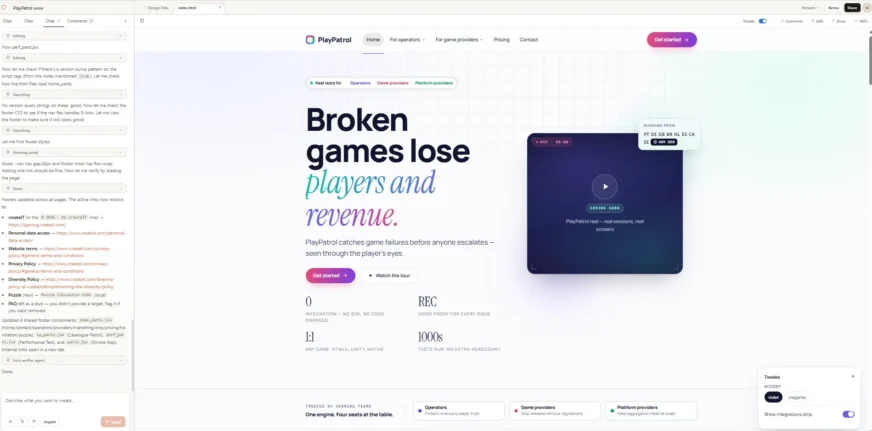
The interface is highly calculated. It splits the user screen cleanly. The chat sits on the left, while the canvas rendering sits on the right. You do not write code to manipulate the generated application. You simply adjust visual sliders. You tweak spacing, color, and layout in real-time without ever touching CSS. Applying established design systems automatically solves a massive consistency problem for large organizations. However, treating digital creation solely as a solved mathematical equation ignores the friction required to build genuinely novel products.
The aesthetic-usability effect dictates that users perceive attractive interfaces as inherently more usable. The system leverages this bias by dressing statistical guesses in beautiful, curated typography. You trust the layout implicitly. The system ingests your existing brand guidelines automatically. It reads your corporate code repositories and Figma files. Automated brand extraction ensures the output rarely looks like a generic template. It looks exactly like your company, just generated at massive scale. The user’s role shifts from direct creation toward selection, refinement, and constraint-setting.


What happens under the hood
The elegant interface hides severe physical and computational constraints. Every interactive component generated by the system requires multiple inference passes and massive GPU memory allocation. Generating interactive 3D web components consumes vast server resources. Under heavy usage, the system load spikes dramatically.
To protect the global cluster, Anthropic relies on aggressive rate limiting and silent compute rationing. This is a necessary reality of maintaining a stable cloud infrastructure. But the jarring transition from limitless creative partner to an unavailable server exposes the fragility of the product illusion. When demand peaks, the system manages the load by degrading response quality or enforcing hard usage caps. A UX lead finalizing a complex presentation might suddenly hit a wall, watching the model struggle to render basic CSS grids because their session token budget was exhausted by three previous 3D renders.
Claude Design Pro-workflow – Maximizing your compute budget
To speed up the workflow with Claude Design, reduce the number of interactions, and achieve the best possible result, you should:
- Carefully think through what should be included on the website, what its purpose is, who the target audience is, and which markets the content will address. Due to the nature of the content, it should be prepared in an .md (Markdown) file.
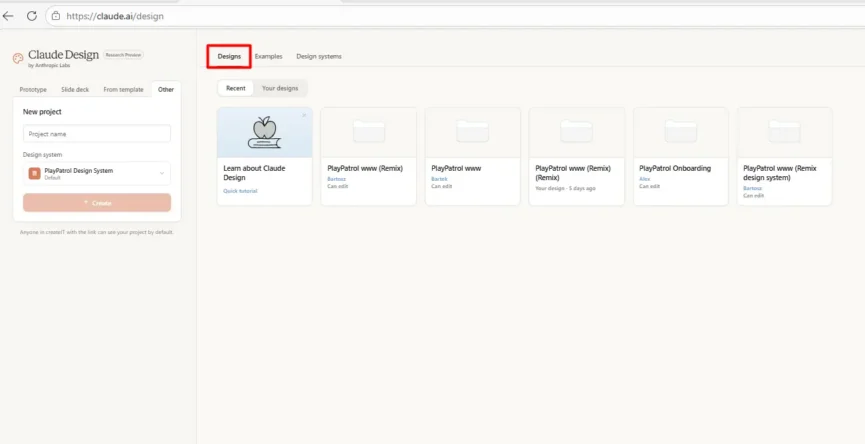
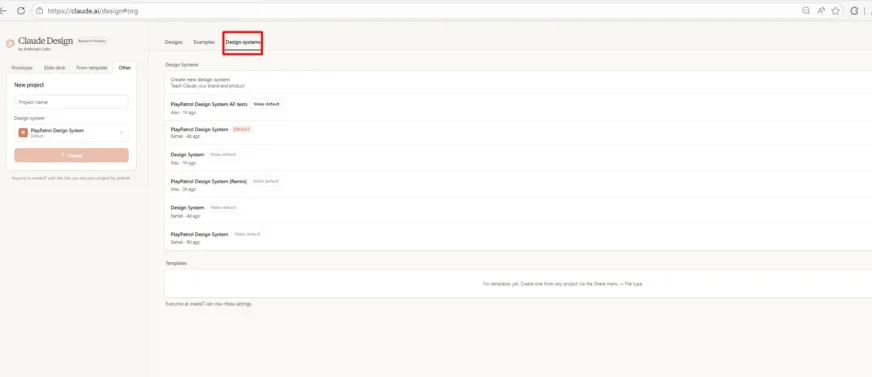
- Add a design system within the system panel – this includes brand guidelines, rules for brand usage, and core assumptions. A design system is essentially an expanded version of a brand book that ensures consistency with the brand.
- Prompting – apply best practices in prompt writing to minimize the number of interactions. The better the output from the first interaction, the better overall. Making changes within the system may lead to issues, including unintended overwriting of design elements.
- When creating a digital product, remember to design a mobile version. Claude Design, by default, does not produce designs that work well on mobile devices.
- Publish the project online.
Of course, Claude Design allows teamwork on a shared project. Not only can we see the result, but we also have access to chats, so we can see the full context of the changes.
Impact on design workflows and roles
Claude Design does not trap your work. It exports it aggressively to PDF, PowerPoint, and Canva. This allows specific teams to bypass professional design silos entirely. You generate the rough draft in Claude, and you apply the final polish in Canva. Strategic deskilling targets the middle layer of the creative industry. Freelancers specializing in high-volume banner production or simple mockups are the first group to feel pressure.
If current adoption trends continue, many mid-size marketing teams may rely primarily on AI tools to generate their initial visual drafts entirely through AI-assisted tools like Claude Design. Professional designers will increasingly focus on system architecture and brand governance rather than visual production. The most consequential integration is with Claude Code. You approve a visual prototype on the canvas. The system packages an implementation bundle with design tokens, handing it directly to the coding agent. The gap between a sketch and a deployed application vanishes. This workflow significantly lowers the barrier to entry for non-technical founders. But throughput optimization serves the machine’s metrics, not necessarily the user’s core needs. Design is rarely just a throughput problem.
Fighting the artificial slop
Left to its own devices, Claude Design often defaults to predictable choices. Internal developer documentation refers to this as the AI slop aesthetic. The model relies on overused system fonts like Arial or Roboto, and clichéd purple gradients on white backgrounds. Anthropic knows this looks incredibly cheap. They actively engineer system prompts to fight their own machine’s lack of taste.
They mandate high visual contrast and draw color inspiration from cultural aesthetics. Visual hierarchy is applied mechanically to fake human intention. They use CSS variables to force consistency across the canvas. It is a highly controlled corporate exercise that packages raw computation in a premium digital wrapper.
This is not the end of design. It is the end of design as an isolated production task. The profession is moving upstream. It is moving toward technical judgment, systems thinking, and ethical responsibility.